


























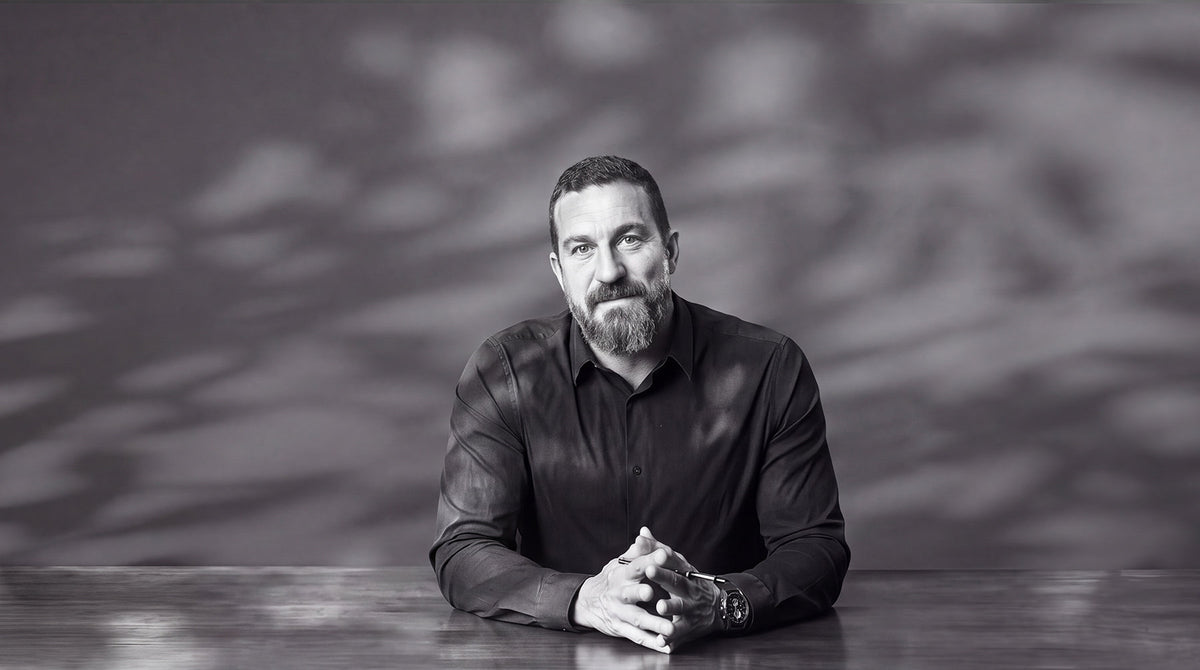
When a neuroscientist with his own academic chair talks about sleep, cold and morning light on a podcast, millions listen. Prof. Andrew Huberman, a neuroscientist at Stanford University School of Medicine, appeared on Steven Bartlett’s «The Diary Of A CEO» on 3 September 2026 – more than two hours on the routines that, in his view, make the greatest difference in daily life. What is interesting is that most of his recommendations cost nothing.
The key points at a glance
According to Huberman, the greatest effects build up from small things repeated daily: morning light for the cortisol rhythm, water straight after getting up and a regular exercise routine, deliberately seeking cold and discomfort to train willpower, calming meals for stable blood sugar, the «physiological sigh» breathing technique for acute stress, and a dark, cool sleeping environment. Almost all of this is free. QUOALA sees itself not as a solution for these routines, but as a small tool that makes them easier to maintain.
In this guide:
- 1. Why a Stanford neuroscientist is talking about your morning
- 2. Morning light: The simplest way to support your daily rhythm
- 3. Water and movement: Sequence and routine matter
- 4. Cold and discomfort: Why willpower can be trained
- 5. Nutrition, breathing and rapid stress regulation
- 6. Sleep: Environment, a technique for night waking and the nightly clean-up
- 7. What this has to do with QUOALA: A tool rather than a solution
1. Why a Stanford neuroscientist is talking about your morning
Andrew Huberman is a neuroscientist at Stanford University School of Medicine, where he leads a research laboratory in the Departments of Neurobiology and Ophthalmology. He also hosts the «Huberman Lab» podcast, translating research on sleep, stress and the nervous system into everyday language, and is working on a book titled «Protocols: An Operating Manual for the Human Body».
His conversation with Steven Bartlett on «The Diary Of A CEO» was not about exotic biohacks, but about a set of habits that, according to Huberman, offer the greatest scope for improving energy, sleep quality and resilience to stress. An important distinction: this remains a podcast conversation, not a peer-reviewed article – the following sections are therefore deliberately phrased as «according to Huberman», not as proven fact. [1]
That is also why this article deliberately does not summarise the entire conversation of more than two hours, but selects the protocols most directly applicable to daily life – without equipment, a subscription or prior knowledge. The following six sections put the key statements into context – and at the end we explain why QUOALA considers itself relevant despite all the free recommendations, rather than distancing itself from them.
Summary: Who Huberman is
Andrew Huberman is a neuroscientist at Stanford University and host of «Huberman Lab». His statements in the conversation with Steven Bartlett are informed, but podcast statements remain cautiously phrased – «according to Huberman», not «proven».
What else Huberman talks about
This article deliberately covers only part of a conversation lasting more than two hours. On his own channel, Huberman organises his content by topic – here is a selection of the most visited:
- Cold exposure & deliberate cooling
- Fitness & training routines
- Light exposure & circadian rhythm
- Mental health
- Sleep hygiene
- Supplementation
- Brain & neuroplasticity
- Focus & concentration
2. Morning light: The simplest way to support your daily rhythm
«Optimal Morning & Evening Sunlight Routine», «Huberman Lab Clips» channel (1.48 million subscribers), published on 17 April 2026, 9 min. 45 sec.
The first and, according to Huberman, most important protocol in the episode is very simple: go outside for a few minutes as soon as possible after waking and let daylight reach your eyes – without sunglasses, even under cloudy skies. He links this directly to the cortisol rhythm: the body naturally produces a rise in cortisol in the morning, which helps determine alertness and focus, and according to Huberman, early outdoor light is intended to reinforce this rise at the right time and align the rhythm for the rest of the day.
The point he emphasises: no device, lamp or app is needed. A window is not enough – light intensity indoors is many times lower than outdoors, even on a grey day. As a rough guide, Huberman suggests around two to ten minutes, ideally within the first hour after getting up – guidance from his own practice, not an exact prescription that must apply equally to everyone.
Another interesting aspect of this recommendation is how it is explained in the conversation: not as a mood booster in the sense of «go outside and you will feel better», but as a signal for the body clock. Huberman describes the principle as the body using morning daylight as a starting signal for its daily rhythm – and an irregular or absent morning light signal potentially shifting that rhythm. So, by this logic, reaching a window or stepping outside late on some days may also shift the rest of the day – including evening tiredness.
There is also scientific evidence for the underlying general principle independently of Huberman: a controlled study measured participants’ body clocks first during normal daily life with plenty of artificial light and little daylight, then during a week with predominantly natural light. The result: with more natural daylight and less artificial evening light, the body clock shifted measurably closer to actual sunrise and sunset. [2] This supports morning light as a cue for the daily rhythm in principle - the specific recommendation of two to ten minutes nevertheless comes solely from Huberman, not from this study.
In practice, this does not mean that missing one morning ruins the whole day – Huberman himself stresses in the conversation that these are probabilities and tendencies, not rigid rules. According to him, anyone unable to get morning light on a rainy day loses little, merely missing a small, free benefit. This measured approach – small adjustments rather than grand promises – runs through the entire conversation.
Summary: Morning light
According to Huberman, daylight shortly after getting up helps support the natural cortisol rhythm at the right time. No equipment needed, just a few minutes outside – one of the simplest and least expensive protocols in the episode. → Our standard: Practice
3. Water and movement: Sequence and routine matter

Immediately after morning light, Huberman mentions two more habits for starting the day: drinking water before coffee or tea, and a structured exercise routine that he describes as a combination of strength, endurance and mobility – not necessarily in the morning, but as a regular part of the week. The thinking behind this is less about biohacking than basic care: the body has lost fluid overnight, and according to Huberman, exercise covering all three components addresses more of the basics than cardio or strength training alone.
His focus is on sequence and consistency – water before caffeine, exercise as a recurring appointment during the week rather than tied to a fixed time of day. In the episode, Huberman also mentions a walk after eating as a simple measure that he associates with more stable blood sugar after meals.
For the exercise routine, Huberman stresses that none of the three components should be absent in the long term, even though many people specialise in one of them:
- Strength – according to Huberman, does not on its own protect against reduced mobility in old age
- Endurance – in his view, endurance training alone builds little muscle mass
- Mobility – does not on its own improve everyday physical performance
He deliberately leaves the precise weekly schedule open – according to him, including all three areas regularly matters more than having the perfect programme.
On drinking water before the first coffee, Huberman adds a thought that runs through several of his recommendations: in his experience, caffeine works most reliably for him when his body is not already slightly dehydrated. In his observation, starting straight away with coffee on an empty stomach instead is more likely to cause restlessness or a later slump during the morning – a simple reason to reverse the order without changing the amount of coffee itself.
Summary: Water and movement
Water before the first coffee and an exercise routine combining strength, endurance and mobility – according to Huberman, the foundation on which everything else builds. A walk after eating is a straightforward addition. → Our standard: Practice
4. Cold and discomfort: Why willpower can be trained
«How Long to Sauna & Cold Plunge for Key Benefits», Dr. Susanna Søberg & Dr. Andrew Huberman, «Huberman Lab Clips» channel (1.48 million subscribers), published on 3 December 2023, 6 min.

Perhaps the best-known part of Huberman’s work is cold exposure – cold showers or ice baths. In the conversation, however, he frames this less as a cold protocol in itself than as one of several examples of his «Comfort Crisis» concept: deliberately and repeatedly entering uncomfortable but safe situations to train the ability to tolerate unpleasant states without immediately avoiding them. This is Huberman’s own interpretation, not a proven transfer effect to any kind of everyday stress. According to Huberman, cold triggers a short-term cortisol and adrenaline response, which he associates with increased alertness immediately afterwards.
The key to his interpretation: cold is not an end in itself, but an example of the underlying principle – according to Huberman, regularly choosing to do something strenuous or uncomfortable trains the same mental ability that also helps with involuntary stress. For him, cold is only one of several accessible examples, not a requirement:
- A brisk walk in the rain without an umbrella
- A deliberately demanding workout
- Daily, focused work on a difficult task – deliberately concentrated time without distraction, spent on something that requires real mental effort
For him, all of this belongs in the same category: a form of voluntarily sought discomfort that, over time, strengthens the ability not to give up immediately when faced with effort. He considers the voluntary aspect important – in his interpretation, imposed stress and self-chosen effort affect the nervous system differently.
This distinction matters to him because it explains why two objectively similar demands – a strenuous working day with constant interruptions versus a demanding workout chosen freely – can feel very different subjectively. According to Huberman, regularly choosing something strenuous builds a kind of buffer over time that also helps people stay calmer under involuntary stress. This is the real reason why, in his account, cold showers are less a wellness trend than an accessible tool for a broader principle.
Summary: Cold and discomfort
For Huberman, cold is one of several examples of the «Comfort Crisis»: deliberately sought discomfort as training for willpower. What counts is not the cold itself, but the repeated experience of tolerating something uncomfortable. → Our standard: Practice
5. Nutrition, breathing and rapid stress regulation
«5-Minute Breathing Exercise / Meditation for Improving HRV», Rick Rubin & Dr. Andrew Huberman, «Huberman Lab Clips» channel (1.48 million subscribers), published on 26 December 2023, 8 min. 22 sec.
On nutrition, Huberman remains deliberately cautious about supplements in the conversation – his basic view is that most people need far fewer supplements than the market suggests and should first address sleep, light and their basic diet. Specifically, he describes calming, starchy meals as helpful for dampening the body’s stress response, especially on mentally demanding days. His reasoning: in his view, stable blood sugar directly affects perceived stress – according to him, anyone starting a demanding day with sharply fluctuating blood sugar has less of a buffer for additional mental pressure.
For acute everyday stress, he describes a specific breathing technique that he calls the «physiological sigh» – usable in a meeting, before a difficult conversation or at night when the mind will not switch off:
- Two short inhalations through the nose
- One long, slow exhalation through the mouth
According to Huberman, this is one of the fastest ways to calm the nervous system in just a few breaths. According to Huberman, its advantage over longer breathing exercises is its brevity: it can be used in two or three breaths, discreetly and without anyone nearby noticing. As a measure for monitoring recovery and stress levels over several days, he mentions heart rate variability (HRV): not a daily diagnosis, but a rough trend indicator of whether the body and nervous system are recovering.
To put HRV into context, Huberman explicitly stresses that the absolute value varies greatly from person to person and says little – what matters, he says, is your own trend over days and weeks, not comparison with others. He reads a decline in HRV over several days as a cue to consciously slow down – less a firm signal than an invitation to look more closely at whether sleep, stress or training are currently out of balance.
Summary: Nutrition and breathing
Fewer supplements, calming starchy meals for stress, and the «physiological sigh» as a quick breathing technique for acute moments of stress – according to Huberman, with HRV as a rough indicator of recovery in the background. → Our standard: Practice
6. Sleep: Environment, a technique for night waking and the nightly clean-up

Sleep takes up the largest part of the conversation. Huberman’s basic recommendation for the sleeping environment is very simple: dark and cool. According to his account, together these are intended to give the body the clearest signals that it is time for sleep – light and warmth tend to work against this. For nights when you wake and cannot get back to sleep, he describes a technique involving slow, deliberate eye movements while lying down, which he links to the natural eye movements that occur when falling asleep.
He connects this with so-called glymphatic activity during sleep – a process through which the brain is thought to remove metabolic waste products. The scientific basis is a widely cited study that measured the space between brain cells during sleep and showed that this space expands considerably during sleep, noticeably speeding up clearance by cerebrospinal fluid. [3] An important distinction: this was demonstrated in a mouse model, not directly in humans. The extent and precise nature of the effect in humans therefore remain subjects of ongoing research, and Huberman himself identifies this in the episode as an area with many open questions. The wording therefore remains cautious – as context for the importance of sleep quality, not as conclusive proof in humans.
In practical terms, Huberman translates these recommendations into a simple set of questions about your bedroom:
- Is it dark enough that you can barely see your hand in front of your face?
- Is the room temperature on the cool rather than warm side?
- Is there a fixed time when screens are switched off?
None of these questions requires a purchase – above all, they call for an honest review of existing evening habits.
For the eye movement technique, Huberman describes a simple approach: while lying down with your eyes closed, move your eyes slowly and deliberately in different directions without turning your head. The idea he outlines in the conversation is that these movements resemble those that occur naturally during the transition to sleep and could help the brain return to that state more easily. He himself points out that this is an observation and a personal experiment, not a validated sleep therapy.
Summary: Sleep
Dark and cool as the simplest rule for the sleeping environment, an eye movement technique for returning to sleep, and the brain’s nightly «clean-up» as context for why sleep quality is so central according to Huberman – a field of research that he himself describes as open. → Our standard: Practice
7. What this has to do with QUOALA: A tool rather than a solution
What stands out about these seven or eight protocols from more than two hours of conversation: almost none of them costs money. Morning light, water, a walk, conscious breathing – that is the core of Huberman’s message, even though he writes books and runs a podcast himself. For QUOALA, this is precisely where the real connection to this topic lies, and it is deliberately indirect: not «buy our product because a scientist recommends it», but a shared basic belief – health is not primarily a purchasing decision. It develops through routines you actually maintain.
You do not need a QUOALA product to be healthy – honestly, that is the starting point for everything we do. Most effective adjustments are simple and free: light, water, movement, sleep, as this article shows. What drives us is more specific: helping people actually make these simple things a habit – the practice, not just the knowledge. That is exactly what we mean when we talk about PRACTICE: the product is not the goal, but a small aid along the way.
An overview of the protocols discussed – all without any purchase required:
- Morning light for the cortisol rhythm, with two to ten minutes outside as a rough guide according to Huberman
- Water before the first coffee, plus an exercise routine with strength, endurance and mobility
- Deliberately sought discomfort – cold, demanding exercise or focused work – as training for willpower
- Calming, starchy meals and a walk afterwards for more stable blood sugar
- The «physiological sigh» for acute stress in seconds
- A dark, cool sleeping environment as the simplest adjustment for better sleep
And this is where the real difficulty lies, barely addressed in the podcast: knowing what to do is not the same as doing it every day. A morning routine rarely fails for lack of knowledge; often it fails because, after three weeks, it feels like a duty rather than a ritual. This is exactly where QUOALA sees its role: not as a substitute for daylight, water or movement, but as a small, tactile anchor that makes an already desired routine easier to maintain in daily life – just as Huberman himself starts with the free basics and only then, if at all, turns to targeted additions.
If you do not yet have a regular morning or evening routine, you can start with the free elements Huberman describes – morning light, water before coffee, a walk. If you are already looking for a routine that includes a short, mindful body care ritual, QUOALA Magazine offers a practical starting point. A product does not change your cortisol rhythm or sleep quality – but in everyday life it can make the difference between a routine that feels like a duty and one you actually look forward to in the morning. And that is what matters if a habit is to last for weeks and months.
Summary: The QUOALA connection
Most Huberman protocols are free – light, water, movement, breathing. QUOALA does not replace any routine; as a small, tactile tool, it makes a routine easier to maintain. The product is an aid, not the point.
A routine rarely starts with a product – but the right one can make it easier
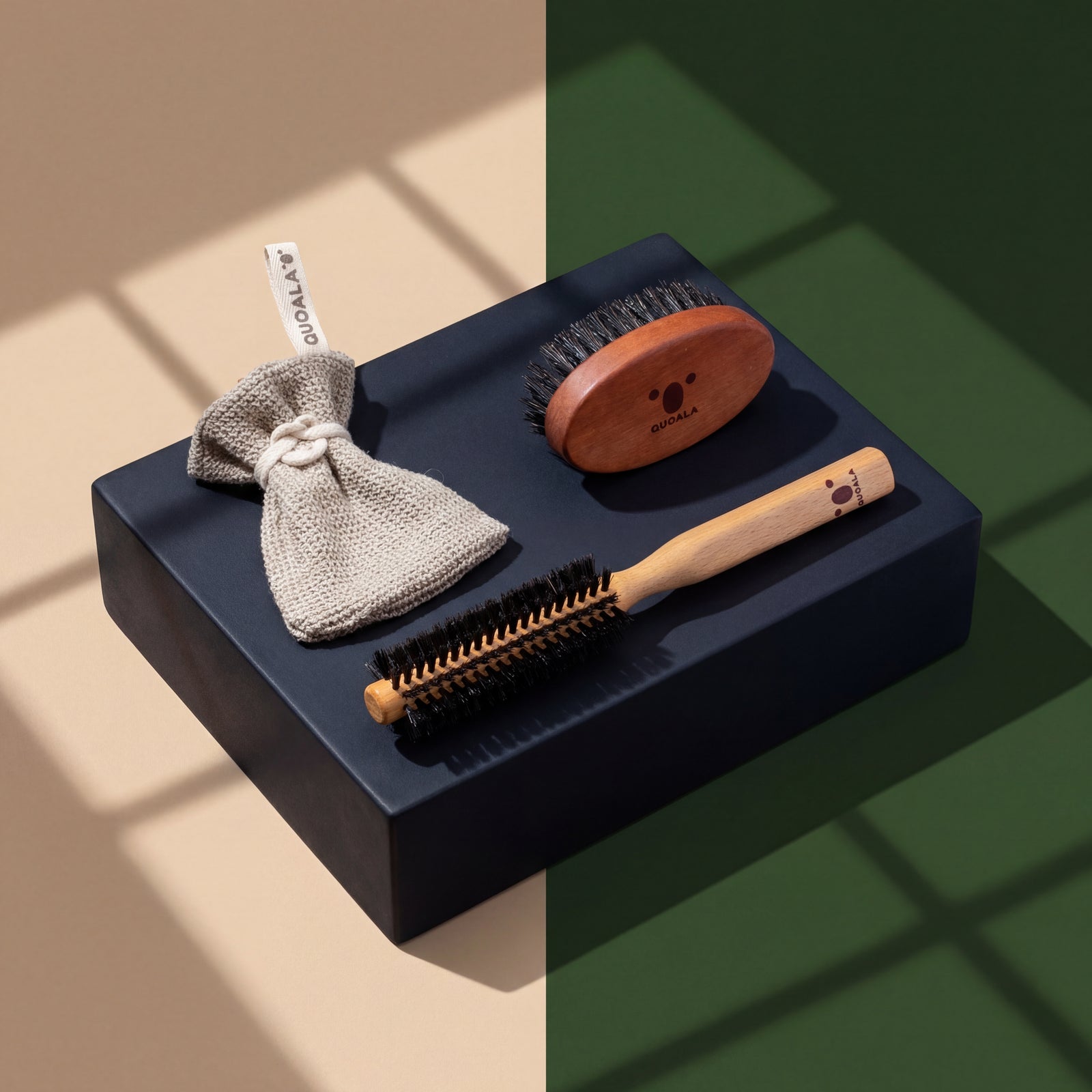
If you already want to add a short body care ritual to your day: our natural brushes made from FSC-certified wood are no substitute for sleep, light or movement – just one more small, pleasant element.
Sources and further reading
Scientific references
- Bartlett, S. (Host) (2026), Andrew Huberman: The Real Reason You Can't Get Deep Sleep & Wake Up Exhausted, The Diary Of A CEO, 3 September 2026. Podcast conversation with Prof. Andrew Huberman (Stanford University School of Medicine); source for all statements labelled «according to Huberman», not a study. Source
- Wright, McHill, Birks, Griffin, Rusterholz & Chinoy (2013), Entrainment of the human circadian clock to the natural light-dark cycle, Current Biology. Human study: with more natural light, the body clock shifted closer to sunrise and sunset. Not the source for Huberman’s recommendation on the number of minutes. Context Z4 · Source
- Xie, Kang, Xu et al., Nedergaard (2013), Sleep drives metabolite clearance from the adult brain, Science. Study in mice: during sleep, the space between brain cells expands and metabolic waste products are removed more quickly. Less established in humans. Context Z3 · Source
External literature (further reading)
- Stanford University, profile of Prof. Andrew Huberman (Departments of Neurobiology and Ophthalmology). Stanford profile
- «Huberman Lab», Huberman’s own podcast, separate from the episode discussed here. YouTube channel
- «The Diary Of A CEO», Steven Bartlett’s podcast, which published the episode discussed here. YouTube channel
QUOALA Magazine
- Building a Morning Routine: How to Make It Stick
- Building new habits: habit stacking explained simply
- Reducing Stress: 7 Ways That Really Help in Everyday Life
- Jordan Peterson: Small Steps That Last in Everyday Life
- Dry Brushing 2026: Body brushes, routines and monastery brushes
- Body brushes and wellness: What studies really show